

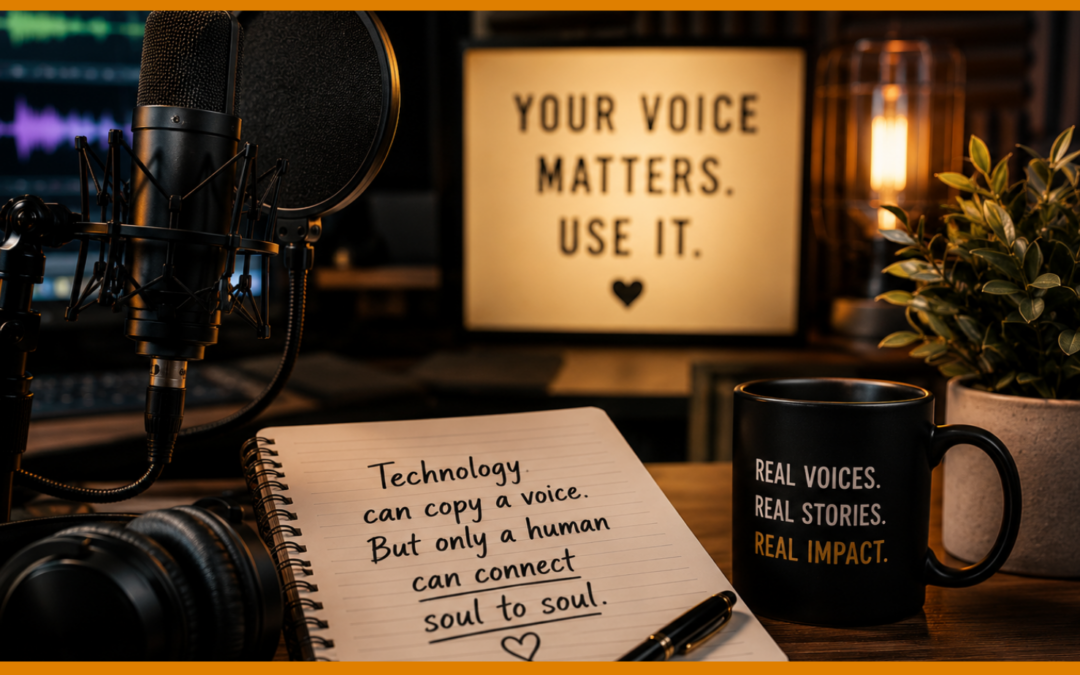
AI Can Copy a Voice. But Can It Make You Feel Something? Why Authentic Voices Matter More Than Ever
Artificial intelligence can copy a voice. Even writing that sentence feels surreal. A few years ago, it might have sounded like the opening line of a science fiction movie. Today, it’s simply another Tuesday in an increasingly AI-powered world.
With enough audio, technology can now recreate tone, pacing, pronunciation, and vocal patterns so convincingly that it can generate speech a person never actually recorded. It’s fascinating. It’s innovative. And if we’re being honest, it’s also a little unsettling. As someone who has spent a career studying voices—not just how they sound, but why they resonate—I keep returning to one question that matters more than any technological breakthrough: Can you actually feel it?
The human voice has never been just sound. Have you ever answered the phone and immediately known something was wrong before the other person said a word? They told you, “I’m fine,” but something in the pause, the breath, or the way that single word landed told you everything you needed to know. That’s because communication isn’t merely about the words we choose; it’s about the emotion carried beneath them. It’s the laugh that sneaks into a sentence, the warmth that appears when someone talks about the people they love, or the slight crack in a voice when emotion unexpectedly surfaces. Human beings don’t simply hear one another—we listen for one another. We instinctively recognize sincerity, vulnerability, joy, and pain through subtle vocal cues that no script can manufacture. I don’t think we always appreciate just how extraordinary that ability really is.
Technology has always reshaped how we live and work, and I appreciate the convenience it brings. I’m certainly grateful I no longer have to unfold a paper map on the side of the road or pull over to ask a stranger for directions who says, “Turn left when you see the school on the corner.” Today, AI helps us navigate traffic in real time, finishes our sentences while we type, catches spelling and grammar mistakes before we hit send, recommends the next movie or song we might enjoy, filters spam from our inboxes, translates conversations across languages, summarizes lengthy documents in seconds, and even helps doctors detect diseases earlier than ever before. These innovations save time, increase productivity, and open doors we couldn’t have imagined just a few years ago.
Progress isn’t the problem. My concern is something much deeper. What happens when we become so captivated by what technology can imitate that we stop developing the qualities that make us unmistakably human? There is an enormous difference between generating sound and communicating meaning. AI can produce a convincing voice, but authentic connection has always required something more than accurate pronunciation and perfect pacing.
Ironically, one of the greatest challenges many people face has nothing to do with artificial intelligence. It’s the constant pursuit of perfection. If you’ve ever recorded yourself speaking, you know exactly what I’m talking about. Suddenly, every breath feels too loud, every stumble feels catastrophic, and every sentence becomes an opportunity for self-criticism. Trust me—I have listened back to my own recordings and thought, “What exactly was that?” We’ve all been there. Yet sometimes we’re so focused on polishing our voices that we accidentally polish away our personality. The voices we remember most are rarely flawless. They’re memorable because they’re authentic. Perhaps it’s a warm texture, a distinctive rhythm, an unexpected pause, a contagious laugh, or even a slight rasp that makes someone instantly recognizable. Those characteristics aren’t imperfections. They are identity. They’re the fingerprints of your voice.
This conversation actually began long before artificial intelligence entered the picture. Voice actors have compared themselves to other voice actors for decades. Speakers compare themselves to keynote presenters. Singers compare themselves to chart-topping artists. Content creators compare themselves to everyone. Somewhere along the way, we convince ourselves that success requires sounding like someone else. But here’s the truth: their voice already has a career. Yours deserves one too. Instead of chasing another person’s sound, become curious about your own. Study it. Train it. Protect it. Notice what happens when you’re relaxed, when you’re genuinely excited about a topic, or when you’re speaking from lived experience instead of simply reading words from a page. Your voice will teach you far more than you realize—if you stop criticizing it long enough to actually listen.
We’re surrounded by constant notifications, endless content, and conversations happening faster than ever before, yet genuine listening has become surprisingly rare. This month, I invite you to slow down. Listen to the people around you. Can you hear beneath their words? Listen to your environment. Most importantly, listen to yourself without immediately searching for flaws. Here’s a simple challenge: record yourself talking about something you genuinely love. Don’t write a script. Don’t rehearse. Don’t perform. Simply talk as though you’re speaking with a close friend. Then play it back. You may discover a version of your voice you’ve been unintentionally editing out for years—the version that feels the most authentic.
I don’t pretend to know exactly what the voiceover industry—or communication itself—will look like ten years from now. What I do know is this: people will always crave authenticity. We want stories that move us, conversations that make us feel understood, and voices that remind us another human being is on the other side of the message. Technology will continue evolving, and we should absolutely learn how to use it wisely. But our greater responsibility is to keep developing the person using the technology. AI may be able to replicate a voice, but it cannot duplicate your lived experiences, your perspective, your resilience, your memories, your compassion, or that indescribable quality people hear when you’re completely present. Those are the things that create trust, inspire connection, and leave a lasting impression. Those are the things worth protecting.
As a home-school mom, speaker, clergy, leader, voice actor, podcaster, educator, performer, or simply someone who wants to communicate with greater confidence, remember this: your voice isn’t just an instrument. It’s an extension of who you are. Train it like the athlete it is. Care for it. Strengthen it. Protect it. Because in a world where artificial voices are becoming increasingly common, your authentic voice has never been more valuable.
If this article encouraged you to think differently about your voice, I hope you’ll share it with someone who needs the reminder that they don’t have to sound like everyone else. For more conversations about voice performance, vocal wellness, communication, creativity, and life behind the microphone, subscribe to the newsletter and become part of the growing Voice Athlete™ and RESToday™community. You can also follow me on Instagram @keaversvoice for practical voice training tips, behind-the-scenes moments, encouragement, and daily reminders to protect the most valuable instrument you’ll ever own. And before you go, one final reminder—you knew it was coming—drink some water. I’ll see you back in the booth.
Recent Comments